
GRAB THE LIVE WIRE
on the work of living, loving, and hoping. also? fuck doomerism.

Recently, a friend of mine shared the following excerpt of an interview with Hanif Abdurraqib with me, saying it made them think of me:
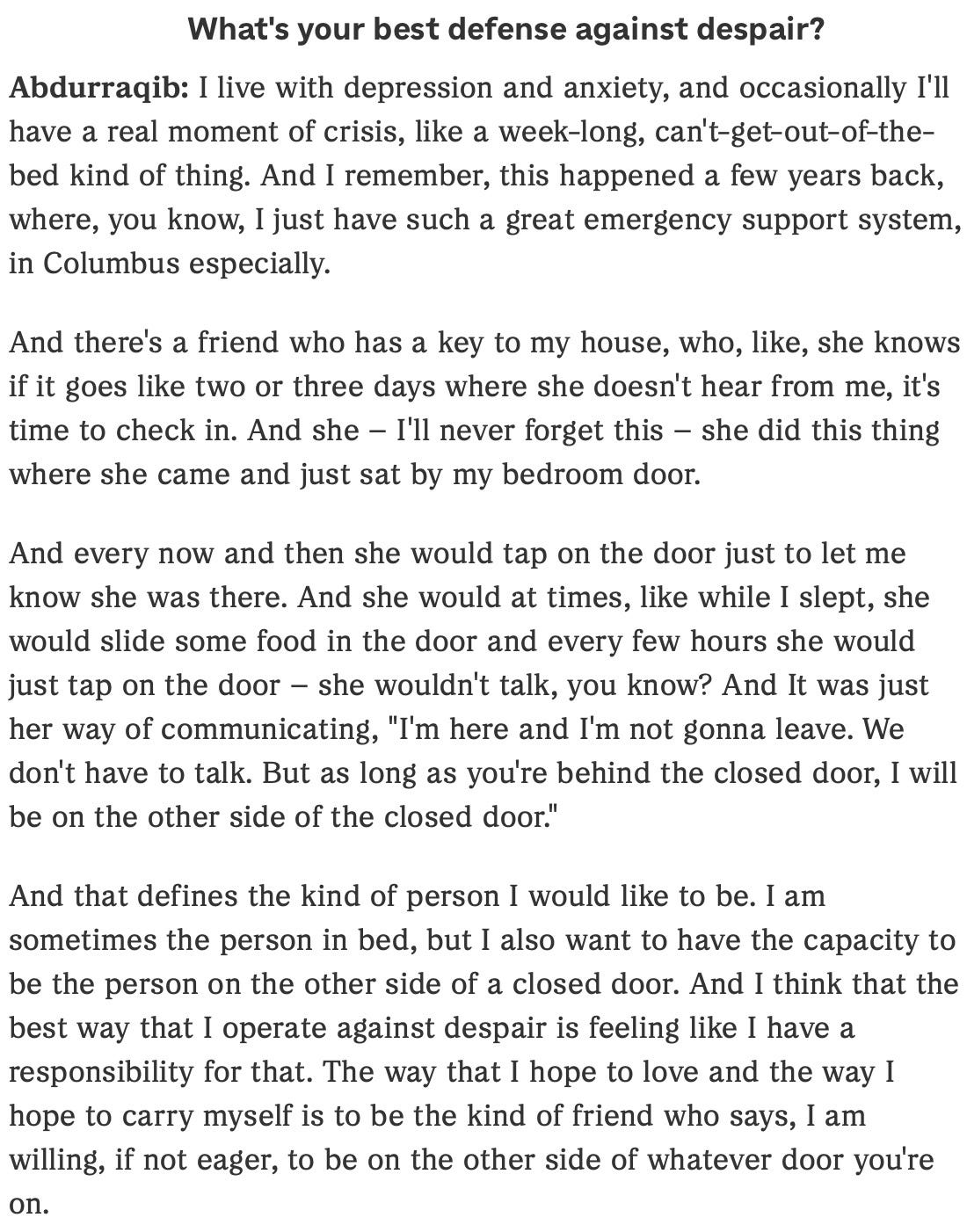
I was reminded immediately of how John Green describes hope, as not only a “prerequisite to survival” but as “the correct response to consciousness.” When my friend sent me this quote, I said the following to them:
[Hope] as this thing that keeps us alive, this force that wills us to show up for one another— whether to listen or to sit in the silence together— and it’s a livegiving force. A moment of breathgiving clarity that makes you realize “oh. right. this is why I’m here. to love and be loved.”
[…] and I think, more than anything, I want to be a person who loves others into their futures, even if only for a season.
This notion of loving others into their futures sits at the crux of my politics, I’ve come to realize. It shows up in how I love the world, how I want to see the Earth persist in the face of human-made destruction. It shows up in my deep, abiding faith in and love for the human story. I want to love this world and the people in it into a brighter future.
A few months ago, I was talking to this same friend and I said to her:
I want a softer world for the next generation. I want a kinder world full of more light soaked joy and less horror. I want to leave this world knowing the kids will be alright.
And what is that if not a desire to love people into their futures? I think, more than anything, I believe that people are worth it. I think not only can we all do better by and for one another, but I believe we all deserve it. We owe it to each other. And I think we only achieve this better, we only manage to love one another into our futures, when we choose intentionally to be alive together. When we grab that live wire and say “no matter how shit, no matter how hard, we will stay here in this moment together and alive.”
Grab The Live Wire
“Grab the live wire” is a turn of phrase I’ve recently become quite fond of— as far as I can tell I cooked it up in my own mind palace at some point. To grab the live wire is to confront the visceral nature of life. It is to acknowledge that to go beyond survival into truly and intentionally living is oftentimes frightening but incredibly rewarding. To grab the live wire is to understand that being alive will rip you into yourself and that this process will be intense and messy and shattering. But most of all, it will be worth it.
In the words of Hanif Abdurraqib, once again, “I picked a pretty rough time to actually want to be alive.” Grabbing the live wire isn’t easy, but I think that’s sort of the point? Not to say there is nobility in suffering, but rather that we mustn’t approach attempts at social change or a radical redefinition of life from a perspective of ease. If it were easy, we wouldn’t have to constantly remind ourselves and one another to do it. To grab the live wire is difficult precisely because we live within a social order that benefits from our apathy and despair; and it is for that very reason that we must fight so hard to grab it anyway.

The quickest way to get me to check out of a discussion of radical hope is to tell me any version of “ugh but it’s so hard.” Not because the statement isn't true, but because I straight up do not care anymore.
Yes, it is hard. So what? So you’re not going to try? So you’re going to give up and wallow in nihilism and despair? Radical hope is not about nice little platitudes; it’s not about empty or toxic optimism. Radical hope is about a foundational shift in your worldview, in your politics, in your actions.
What people often misunderstand in discussions of hope is the labor that goes into it. To steal some verbiage from a famous-to-me tweet, hope is not ephemeral. Hope is gritty and raw and jagged. Hope is homegrown and fought for. Hope is bloody knuckled and unrelenting. In other words, hope is not nice and it does not ask nicely. Hope demands. Demands better, demands us to work harder, to fight harder. Hope is the voice in your ear telling you to get back up and keep pushing; pushing for a kinder world, pushing for a brighter future, pushing for a softer fall the next time you go down.
I’m uninterested in a discussion regarding the difficulty in hope, because that’s not the point. Going back and forth about how hard everything is is not only unproductive but it’s boring. It’s lame. At a certain point you have to accept that we all do hard things; that we must do hard things.
And I guess this is just me saying that, in 2026, I’m not entertaining conversations about hope that center ease or the lack thereof. Because if I’m being honest with myself and with you, dear reader, the times I’ve reached for hope most desperately and most intensely were the hardest moments in my life.
I think of the height of anti-Asian hate during the pandemic. I think of the days following the 2024 presidential election. I think of the day I learned USAID was cut, that PEPFAR was stopped. I think of growing up in a world with active shooter drills in school. I think of watching genocide play out through a phone screen.
Has it been easy? Fuck no. But in 2026 I’m tired of having to always add that caveat. So, this is the last time you get it from me. Yeah, it’s fucking hard. My question to you is, will you do something about it or will you keep complaining about difficulty so incessantly that you stagnate?
Doomerism is a plague on this Earth
Maybe that’s a bit dramatic but fundamentally, I find doomerism to be a deeply uninteresting worldview. I understand the allure of despair. I understand the appeal of cynicism. But at the end of the day I just think you have to be a bit boring to be a doomerist all the time. The biggest antidote to doomerism is, in all honesty, touching grass.
I am reminded of why I believe in the human story every time I spend time with my friends. Whether we are getting dinner at our favorite Thai restaurants or spending an afternoon at the art museum. Whether we’re simply watching the sunset together or exploring a bookstore. Getting out of my house and putting my phone in a pocket for a few, uninterrupted hours never fails to revitalize me. It never fails to remind me of why I so desperately love being alive.
To defeat doomerism you must build community, it is the only thing that will save you. That will save us. And the work to build community is just that, work. I’m reminded of some words by my brilliant friend, Gigi:
Being in community with others is a self-sacrifice in the pursuit of love, a love that is not beholden to the imaginary ladder of relationship hierarchy that threatens to shackle us to imperialism, a love that gives back nearly as much as it takes, a love that promises reciprocity in return for surrender.
Asian Women** Don’t Want Community, They Want White Saviorism
The work of community— of making sure I live a life where I see the sky and feel the sun on my face and see real, tangible art and the eyes of my friends without a screen to separate— is work I will do happily and willingly. When I say you must grab the live wire, I mean that you must let yourself be opened up to love. I think, perhaps, you only truly grab the live wire when in your other hand is the hand of someone you love.
As we enter a new year, one that feels fraught and cataclysmic already, I urge you all to grab the live wire with me anyway. I ask that you adopt a hope that is more than a feeling. I ask that we abandon doomerism and move forward with eyes that seek reminders of why we fight so hard in the first place. I ask that whether it be through gritted teeth or broken sobs, you engage in the ever rewarding endeavor that is cultivating a persistent and steadfast hope.
I believe, in spite of it all, that the human enterprise has value.
John Green, The Anthropocene Reviewed
May you find value in the human story alongside me. May you be surrounded by people who make this work feel that much less rotten. May this all seem like such common sense one day.
Lovely piece, especially in the trying times we’re facing right now.